



If you're looking for a Shopify development agency, you want 3 answers before you send a single message: what they've really built, how they work, and what it will cost you. Most agency pages show a portfolio grid and a "get a quote" button. This page shows our real builds, the hours they took, how a project runs from the first call to launch day, and our prices.
I'm Nick Ursu. I've worked only on Shopify for 9+ years, and my team has done 1,300+ Shopify projects since 2017. The team is 2 designers, 2 developers, an email marketing specialist and 2 conversion experts. I lead the strategy and the conversion work, and we design every page in Figma before anyone writes code. I run the work from Bali (UTC+8), Monday to Saturday, with clients in the US, Canada, the UK, Ireland, Switzerland and Australia.
Bonus: before you talk to any agency, check your own store with our free Store Analyzer. It looks at your theme, apps, speed, reviews, cart, product page and SEO, and gives you 20+ tips in about 30 seconds. You'll know what to ask for.
Quick overview
- Who builds it: Nick Ursu and a team of 2 designers, 2 developers, an email marketing specialist and 2 conversion experts
- What we build: new stores from scratch, redesigns, moves to Shopify, B2B order forms, carts with upsells and the emails that go with them
- How: design first in Figma, you approve, then native Shopify code (no page builder), tested on a copy of your theme
- Price: $45 an hour for new clients, $35 an hour once you're a client, every task estimated before we start
- Real timelines: a dental lab store in 30 days and 50 hours, a premium apparel brand in about 150 hours
What a Shopify development agency should do for you
Development is the code. But a store that sells needs more than code: a design that fits the brand, a product page that answers questions, a cart that doesn't lose the sale and emails that catch the people who almost bought. If an agency only codes, you end up hiring 3 more people after launch.
That's why the team is built the way it is. These are the jobs we do most:
- New stores from scratch. Brand, design system, every page designed and coded. See how we create a custom branded Shopify store.
- Redesigns of live stores. Same products, a store built to convert. Our redesign page shows how we plan it.
- Moves to Shopify from WooCommerce, WordPress, Wix, SunShop and others, with redirects so you keep your Google traffic. Prices are on our Shopify migration service page.
- Custom features: bundles, B2B order forms, product options with extra prices, subscriptions.
- Cart and checkout: free shipping bars, upsells, one clear checkout button.
- Emails before launch: welcome, abandoned cart and abandoned checkout, designed in the same style as the store.
Real builds, real hours
Here's what some of our builds took, from our own project tracking. I'm showing hours because they tell you more than a price ever will: they show how much work really goes into each type of store.
| Project | What we built | Time |
|---|---|---|
| dotdotsee, men's performance apparel, Dublin | Waitlist page, design system and every page in Figma, founders bundle, native code, cart with Flex Upsell, 3 email automations in Omnisend | About 150 hours, April to October 2026 |
| Scent Bar by Angela, perfume sprays, New York | A new store for the owner of GoldStar Fragrances, our longest monthly client | About 80 hours |
| Futureface, skin nutrition, Canada | Move from WooCommerce, redirects, reviews to Judge.me, Appstle subscriptions | 80 hours in 3 weeks, sales on launch day |
| Lightning Dental Lab, B2B, Canada | Figma design, homepage and product pages, mega menu, product options with extra prices, video training for their team | 50 hours in 30 days |
| AIS Tours, guided tours, Switzerland | Custom redesign in Figma, then the Shopify build | About 50 hours (2025) |
| A custom metal cards brand, US | Brand guide from scratch, custom theme, homepage, product and collection pages | Under 4 weeks |
| A smart mirrors store | Custom theme, design and build | Under 50 hours |
So a simpler store on a good theme is usually 30 to 60 hours. A custom store with its own design and a few special features is around 50 hours. A premium brand built from zero, with a waitlist, a bundle, emails and rounds of changes, can reach 150.
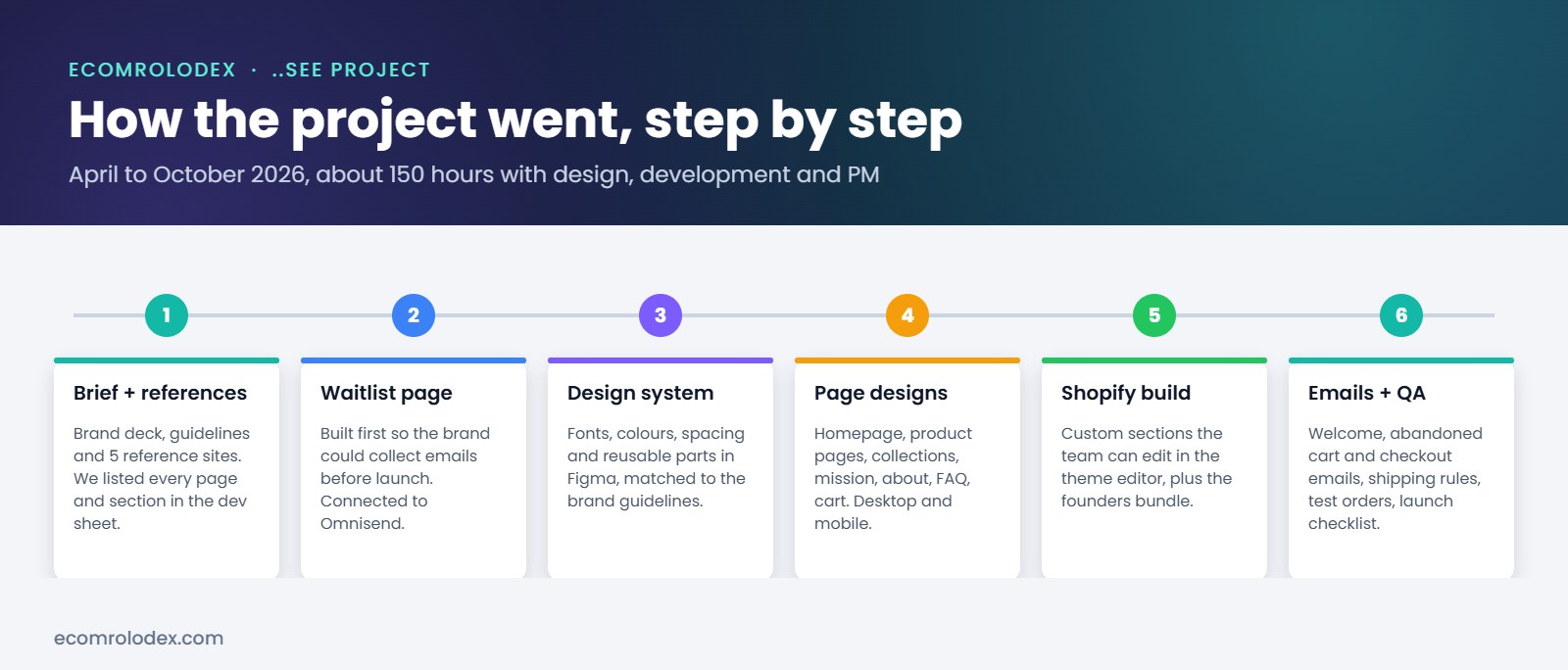
The dotdotsee build from brief to launch: about 150 hours over 6 months, in rounds you approve.
From our projects
We built the waitlist before the store
Michael from dotdotsee came to us with 1 tee and 1 short, and the products weren't ready yet. So the first thing we built wasn't the store. It was a waitlist page connected to Omnisend, so people joined for drop 01 before a single product page existed.
With only 2 products we also built a founders bundle: one tee and one short for €129 instead of €155.98, limited to 200 bundles, with both sizes and colours picked in one place. On a small catalog the bundle is the easiest way to a bigger order. The full story is in the dotdotsee case study.
How we work, step by step
Every project runs the same way, whether it's 30 hours or 150. You always know what's done, what's waiting for you and what's next.
1. Brief and references
You send us what you have: a brand deck, guidelines, products, and a few stores you like. Michael sent us 5 sites he liked, including Vuori, Ciele and On. That one list saved hours of guessing, because we knew the feel he wanted before we drew anything.
2. Design first, in Figma
We design every page for desktop and mobile in Figma. You leave comments right on the design, and we go through rounds there until it's approved. A change in Figma takes minutes. The same change in code takes hours. This is the step where most of your money is saved.
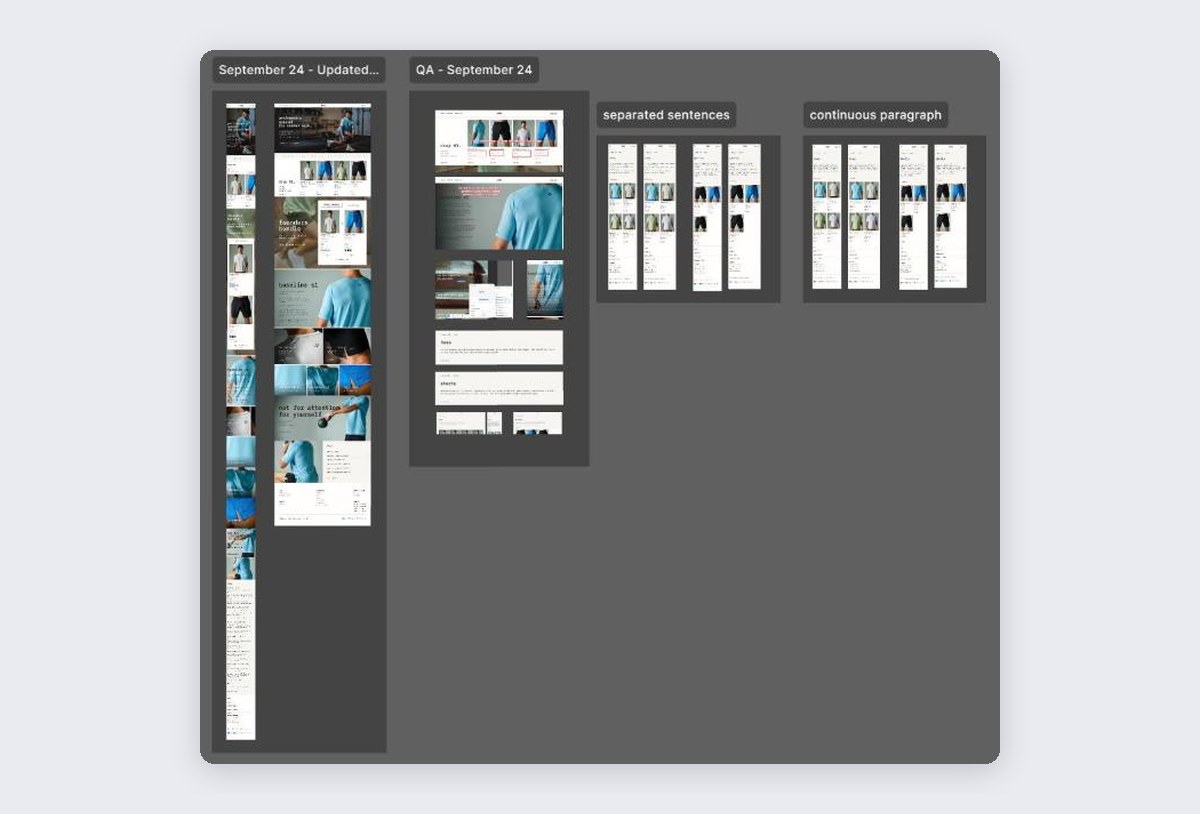
Part of the dotdotsee Figma file: every page and every QA round sits here before any code.
3. Native code you can edit yourself
A lot of stores get built with a page builder app. It's fast for the agency, but the owner pays for it later: a monthly bill that never stops, extra scripts on every page and a store that's hard to change without the app. We code every section natively in the theme, and every section gets its own settings. On dotdotsee, Michael changes the bundle products, the prices and the "limited to 200" badge himself in the theme editor.
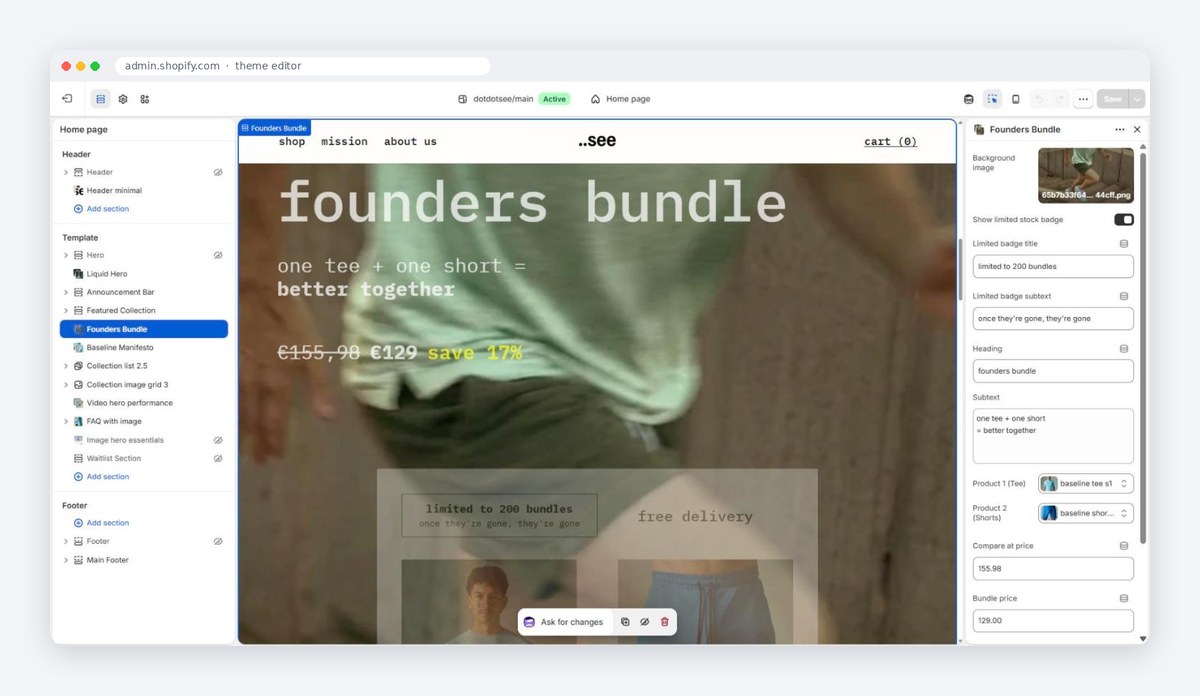
The founders bundle in the Shopify theme editor: heading, products and prices are fields the owner edits, no code.
4. Tested on a copy of your theme
We never test on your live store. You add us as a collaborator (Shopify explains it in its collaborator accounts guide), we duplicate your theme, build and test there, and only publish once everything works. Your customers keep buying on the old version the whole time.
5. One dev sheet for every task
Every project has a dev sheet in Google Sheets. Each page and each task has a number, the hours and a status, so you can see what's done and what's waiting for your review without asking. Quick questions go on WhatsApp, bigger ones on a Google Meet call. A 30 minute call saves a week of messages.
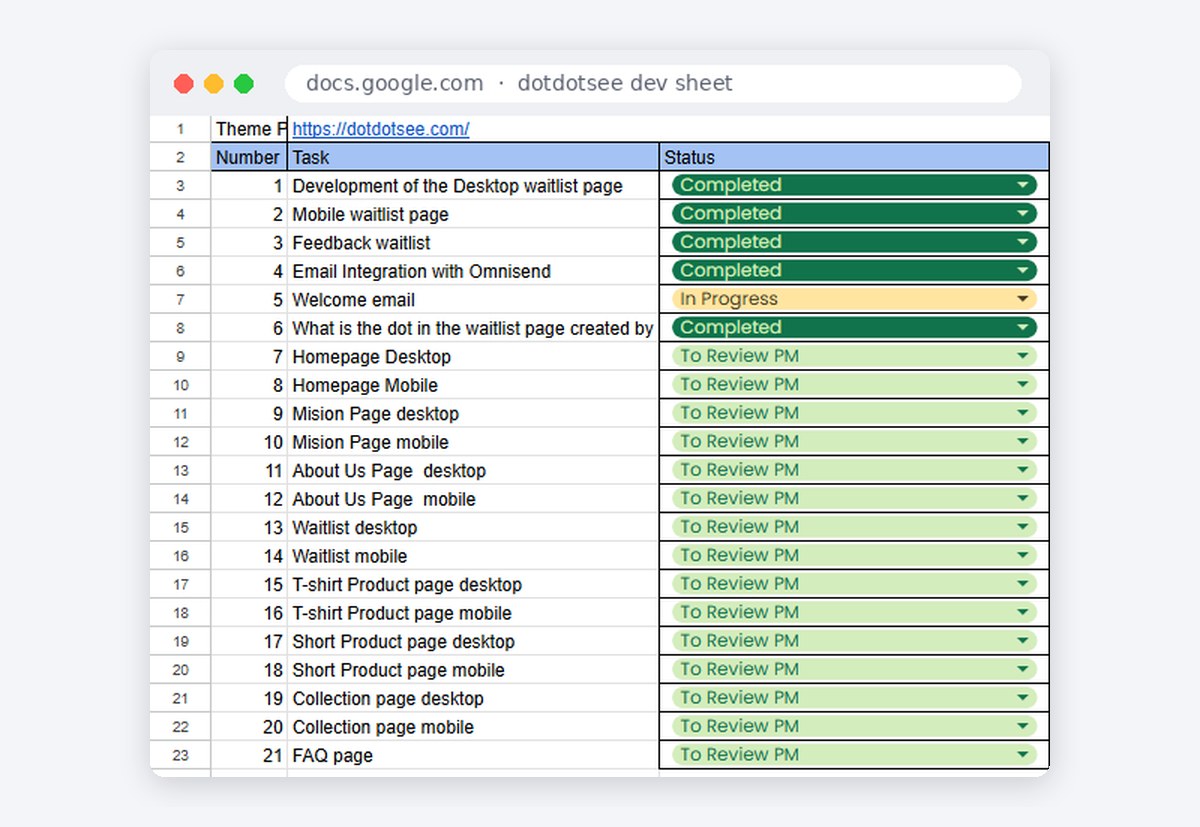
Part of the dotdotsee dev sheet: one row per task, with a status the client can see any time.
6. Launch, training and what comes after
Before launch we test on desktop and mobile, place a test order and check the emails. Then we teach your team. For Lightning Dental Lab we recorded videos on how to change the website, manage orders and handle customer emails, so they could run it without us. After launch, most clients keep us for the next job: emails, speed, conversion work.
Planning a build or a redesign?
Send me your store or your idea. I'll tell you how I'd build it and roughly how many hours it takes, before you pay anything.
From our projects
Moving a dental lab's orders online in 30 days
Lightning Dental Lab in Canada took orders the old way. Dentists needed to order crowns and other work with options like shade, finishing and how they send the case, and each option can change the price. A standard Shopify product page doesn't add a price per option on its own.
We designed the homepage, product pages and a mega menu in Figma, then added an app for the product options so each choice adds its own price. Budget 50 hours, timeline 30 days, both kept. The dental lab case study has the full process.

A dental lab product page we built: shade, file upload and finishing options, each with its own price.
From our projects
A mistake we fixed: two people editing one theme
This month a client edited her store while my team was working on it. Nothing broke badly, but part of the same work had to be done almost twice, and that's hours the client pays for.
Now we agree at the start who works when. If you want to change something during the build, tell us, we pause, you edit, and we continue after. It sounds small, but it's the most common way a build goes over its hours.
What it costs
We charge by the hour: $45 an hour for new clients and $35 an hour once you're a client. Before we start, every task goes in the dev sheet with its hours, you approve it, and you pay a deposit. Then the work runs in milestones you approve one by one, design first, code second, launch last.
| Job | Hours from our projects | Price |
|---|---|---|
| Simpler store on a good theme | 30 to 60 hours | $45 an hour |
| Custom design and build (like the dental lab or AIS Tours) | About 50 hours | $45 an hour |
| Premium brand from zero (like dotdotsee) | About 150 hours | $45 an hour |
| Redesign of a live store | Up to 150 hours | From $2,000 |
| Move to Shopify: small / standard / large | 30 / 80 / 150 hours | $1,350 / $2,800 / $4,500 |
| Conversion work after launch | 15 or 30 hours | $525 or $950 |
| Not sure where to start | Store review with a video and a fix list | $49 |
Ongoing work like emails and conversion also runs as monthly packages, starting at 10 hours a month.
What makes the hours go up
- Number of page designs. Every template (homepage, product, collection, about, FAQ) is designed twice, desktop and mobile.
- Custom features. A bundle builder, product options with extra prices or a B2B order form each add hours. They're often worth it, but they're never free.
- Content that isn't ready. Photos, product texts and prices that arrive late mean pages get built twice.
- Rounds of changes in code. Changes in Figma are cheap. Changes after the code is written aren't. That's why we approve the design first.
We're not the cheapest option you'll find, and I don't try to be. What you pay for is a team that designs, codes, sets up the emails and then looks at the numbers, all in one dev sheet.
DIY, a freelancer or an agency? My honest take
You don't always need an agency. Here's what I'd tell a friend:
- Do it yourself if you're starting with a few products and a small budget. Pick a free theme from the Shopify Theme Store, add good photos and clear product texts, and spend the rest on getting visitors. You can always redesign once you have sales.
- Hire a freelancer for one clear task: a section, a fix, an app setup.
- Hire an agency when you need design, code, emails and conversion work together: a new brand that has to look premium from day one, a move from another platform where you can't lose your Google traffic, custom features like bundles or B2B ordering, or high ticket products where trust decides the sale.
And one more honest thing: don't pay an agency to chase a perfect Google speed score. A 95+ score on phone is possible, but for most stores it's not worth the budget. A fast first screen and a clear product page matter much more.
10 questions to ask any Shopify development agency before you hire
Use these with us or with anyone else. A good agency answers all of them without blinking.
- Can you show me 3 live stores you built, and how many hours each took? A portfolio of mockups isn't the same as stores that sell today.
- Do you design first and let me approve before you code? If they jump straight to code, every change costs you hours.
- Native sections or a page builder app? Ask who pays the app every month after launch.
- Can I edit texts, images and sections myself after launch? Ask them to show you in the theme editor on a store they built.
- Do you work on a copy of my theme or on the live one? The only right answer is a copy.
- How will I see progress? A task list with hours and statuses beats "we're working on it".
- Who's on the team? Designers, developers, and someone who thinks about conversion and emails, or one person doing everything?
- What happens after launch? Bug fixes, training videos, and who you message when something breaks.
- What's your time zone and how fast do you answer? Same working day matters more than the same city.
- Where can I read reviews you didn't write yourself? Trustpilot and reviews with real names and stores.
Before any of those calls, run your store through the free Store Analyzer. You'll walk in knowing your speed, your app count and what your product page is missing, so no agency can sell you things you don't need.
What our clients say
I'd rather you hear it from them. Simon from AIS Tours in Switzerland wrote this after we redesigned and rebuilt their tours store:

Simon, AIS Tours (Switzerland): about 50 hours of redesign and build in 2025.
And Michael, after about 150 hours on the dotdotsee build:
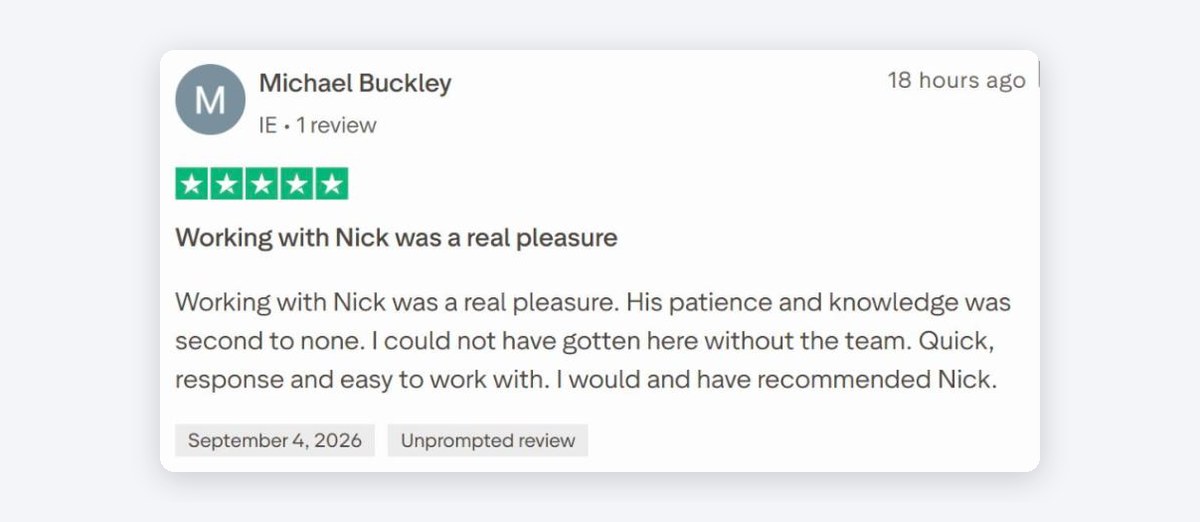
Michael Buckley, founder of dotdotsee, Dublin: 5 stars on Trustpilot.
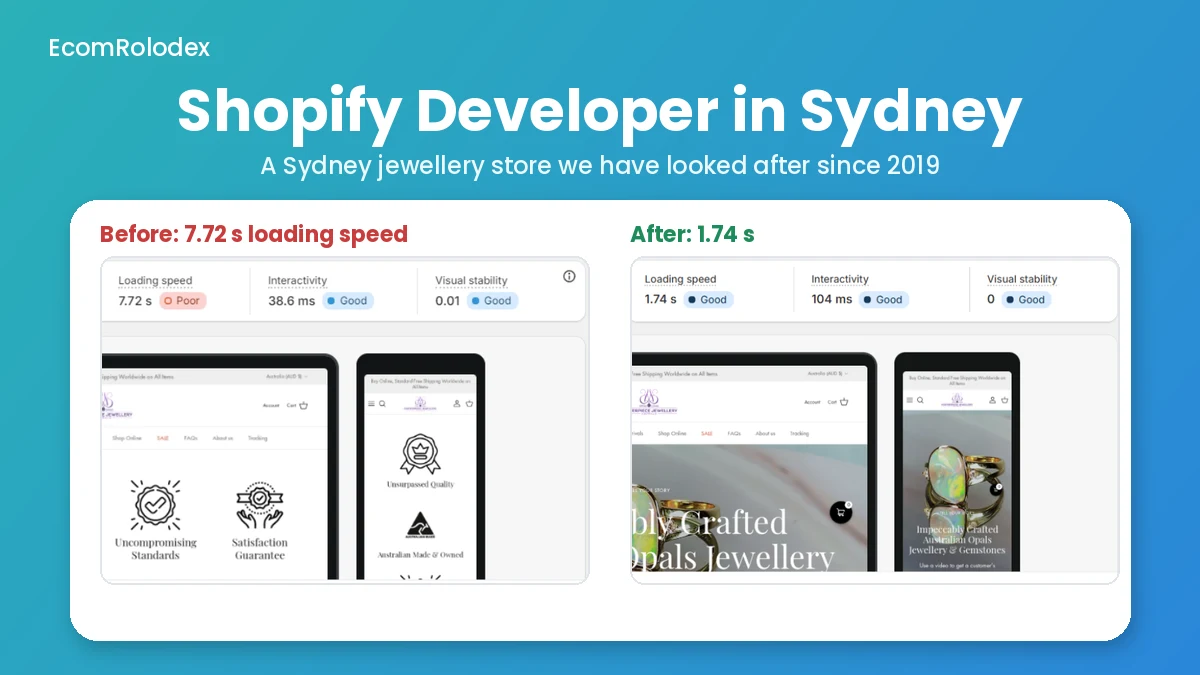
Some clients stay for years. GoldStar Fragrances in New York moved to Shopify with us and we work on the store every month: within a year orders went from about 10 a day to 30 to 50, and conversion from about 1% to 4 to 5%. Masterpiece Jewellery in Sydney has come back to us job by job since 2019, across 5 brands. Glittered Crafts, a full store build, is still a client after a year and a half.
From our projects
The build isn't the end
On November 11 we spent about 5 hours on GoldStar's speed. We didn't change the design at all. We cut the page elements on the homepage from about 11,600 to 4,650, loaded the banner photo first, served the fonts from the store and removed a script nobody used.
Google PageSpeed on the desktop collection page went from 82 to 95. That's the kind of work that comes after launch, and it's why I care how the store is coded on day one. A clean build is cheaper to improve later.

Questions store owners ask before hiring a Shopify development agency
How much does a Shopify development agency cost?
We charge $45 an hour for new clients, so it comes down to the hours: 30 to 60 for a simpler store, about 150 for a premium brand from zero. Redesigns start from $2,000. The table above has every type of job.
How long does it take to build a Shopify store?
Our dental lab store took 30 days. A custom metal cards store took under 4 weeks. dotdotsee took about 6 months, because the products were still being made and we built a waitlist first. In my experience the timeline depends more on design rounds and content than on code.
Will I own the store and the code?
Yes. The store is yours and we work as collaborators on it. The theme sits in your store, and because we code natively, any developer can pick it up later.
Can I edit the store myself after launch?
Yes. Every section we code has its own settings in the theme editor, so you change texts, images, products and prices yourself. We also record video instructions for your team.
Do you work with stores outside the US?
Yes. We've worked on stores in the US, Canada, the UK, Ireland, Switzerland, Australia and New Zealand. I work from Bali, Monday to Saturday, so for Australia and Asia it's the same working day, and for the US and Europe your evening questions are usually answered by your morning.
What if I only need a small fix, not a full build?
Then you don't need a big project. Start with the $49 store review: you get a video and a clear list of what to fix first, and you decide what to do with it.
Looking for a Shopify development agency?
Tell me what you want to build. I'll tell you how I'd do it, how many hours it takes and what it would cost.
Not ready to talk yet? Run your store through the free Store Analyzer and get 20+ tips in about 30 seconds.