


Every month we look at Shopify stores that are scaling with ads, to see what they do differently. This time we ran 100 of them through our own Store Analyzer and counted everything: the apps in their code, the themes they run, what's on their product pages and the basics they skip.
I have built and fixed Shopify stores for 9+ years (1,300+ projects since 2017), so I also added what I'd copy from them and what I'd fix if they were my clients. All numbers are from November 2026.
Key findings
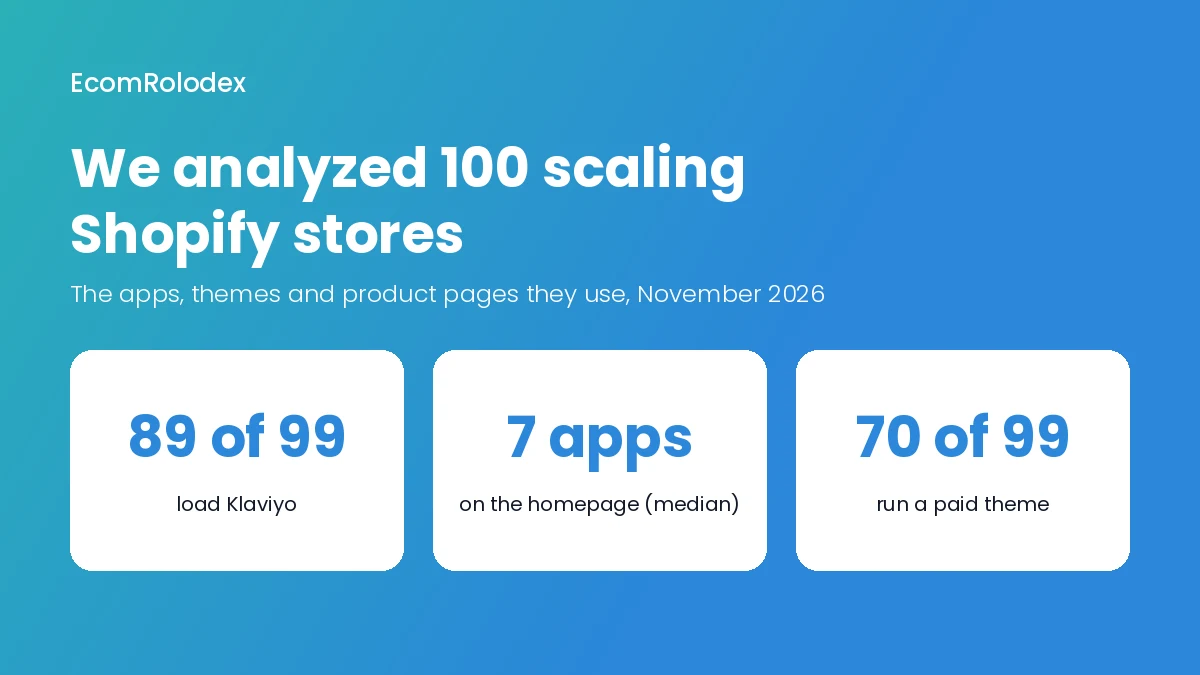
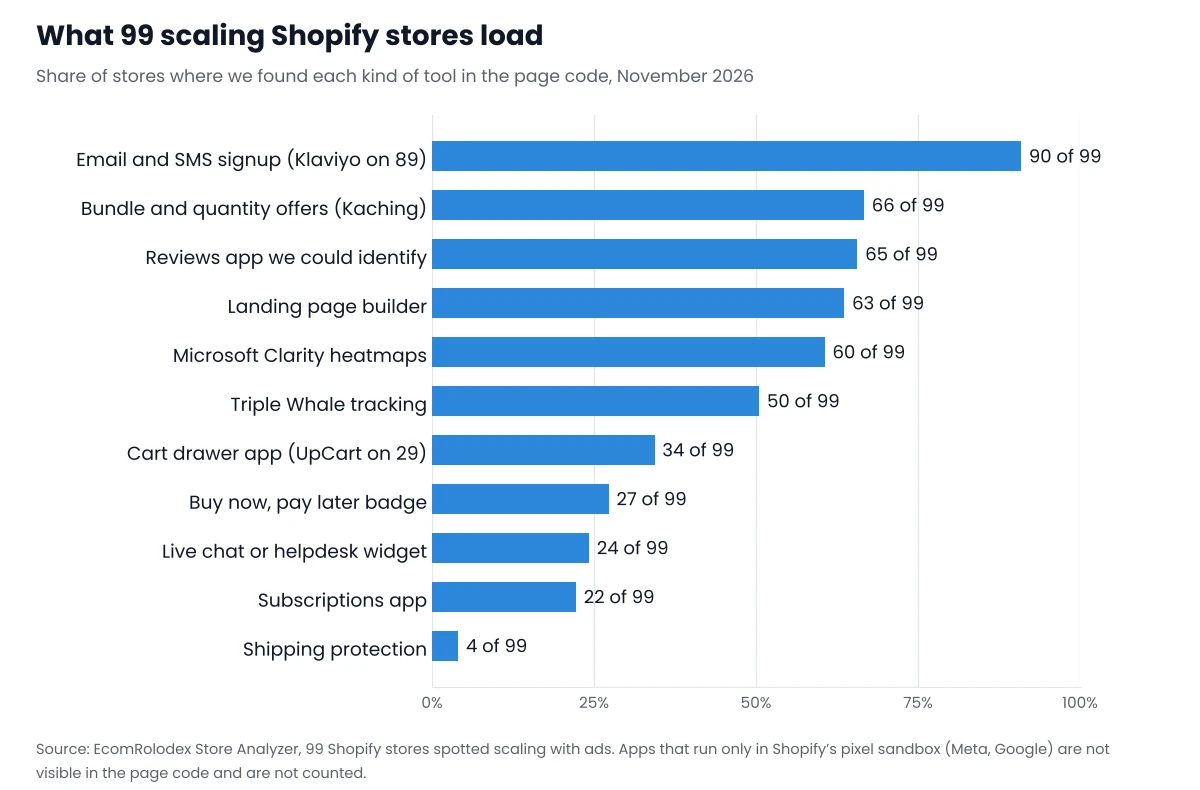
- Klaviyo is everywhere: 89 of 99 stores load it. Only one store with an email signup tool runs it without Klaviyo.
- Bundles sell: 66 of 99 run Kaching, a bundles and quantity offers app.
- Page builders are normal now: 63 of 99 use one, mostly GemPages (38).
- Paid themes win: 70 of 99 run a paid theme. Shrine is the most used (30 stores), then Dawn (22).
- Not that many apps: the median store loads 7 apps and outside scripts on its homepage. Only 6 load more than 15.
- The product page is a checklist: 95 of 99 use a cart drawer, 83 of 97 a sticky add to cart, 85 of 98 show a crossed-out price.
- SEO is an afterthought: 73 of 99 don't link to a blog, 64 have 6+ homepage images without alt text, and only 12 of 82 give Google a barcode in their product data.
Which stores we analyzed
The 100 stores come from our November 2026 list of dropshipping and private label stores spotted scaling with ads in the last months. 73 sell mainly in the US, 9 in the UK, 6 in France, 5 in Australia and 3 in Canada. Most sell one hero product or a small range: supplements, skincare, pet products, home and wellness.
One store was password protected, so the numbers below are for 99 stores. For product page checks we used the first product in each catalog, which we could read on 97 of them.
The most popular Shopify apps on scaling stores
| Kind of app | Stores using one | Most used (stores) |
|---|---|---|
| Email and SMS | 90 of 99 | Klaviyo 89, Attentive 3, Omnisend 3, Postscript 2 |
| Bundles and quantity offers | 66 of 99 | Kaching 66 |
| Reviews | 65 of 99 | Judge.me 38, Loox 13, Okendo 7, Trustpilot 5 |
| Page builder | 63 of 99 | GemPages 38, PageFly 14, Replo 12, Zipify Pages 6, Shogun 4 |
| Analytics and heatmaps | 84 of 99 | Microsoft Clarity 60, Triple Whale 50, Google Tag Manager 30 |
| Cart drawer app | 34 of 99 | UpCart 29, Rebuy 4, Monster Cart 2 |
| Buy now, pay later | 27 of 99 | Klarna 22, Afterpay 8, Sezzle 2 |
| Live chat and helpdesk | 24 of 99 | Richpanel 12, Gorgias 7, Crisp 3 |
| Subscriptions | 22 of 99 | Loop 6, Seal 6, Recharge 5, Skio 3, Appstle 3 |
What I take from it: scaling stores spend their app budget on three things: capturing emails, raising the order value with bundles, and seeing what visitors do (Clarity is free, which is why 60 stores have it). We use Clarity recordings on our own client stores too. On Gold Star Fragrances, watching the recordings every month is how we decide what to test next.
The surprise is how few stores use live chat (24 of 99) or subscriptions (22 of 99), even though many sell supplements and skincare that people reorder. A subscription option on a consumable is one of the easiest wins I see missing.
Which Shopify themes scaling stores use
We found 37 different themes. 70 of 99 stores run a paid theme and 29 a free Shopify theme.
| Theme | Stores | Free or paid |
|---|---|---|
| Shrine (26 on Shrine PRO, 4 on Shrine) | 30 | Paid |
| Dawn | 22 | Free |
| Impact | 6 | Paid |
| Impulse | 4 | Paid |
| Horizon | 3 | Free |
| Eurus | 3 | Paid |
| Sense | 2 | Free |
| 29 other themes | 1 each | Mixed, a few custom |
Shrine is a paid theme made for stores that sell one hero product, with offer and trust sections built in. Dawn is the opposite: fast and simple, and the stores using it add everything else with apps and page builders. Both work. What matters more is what's on the product page, below.
How many apps scaling stores load
We counted every outside script and app embed on each homepage. The median store loads 7, the average is 8 and the most we found was 23.
- 0 to 5: 30 stores
- 6 to 10: 45 stores
- 11 to 15: 18 stores
- More than 15: 6 stores
So no, a scaling store doesn't need 30 apps. When we take a store to a 90+ speed score, removing apps that load on every page is usually the first step (more in our speed optimization service).
What's on their product pages
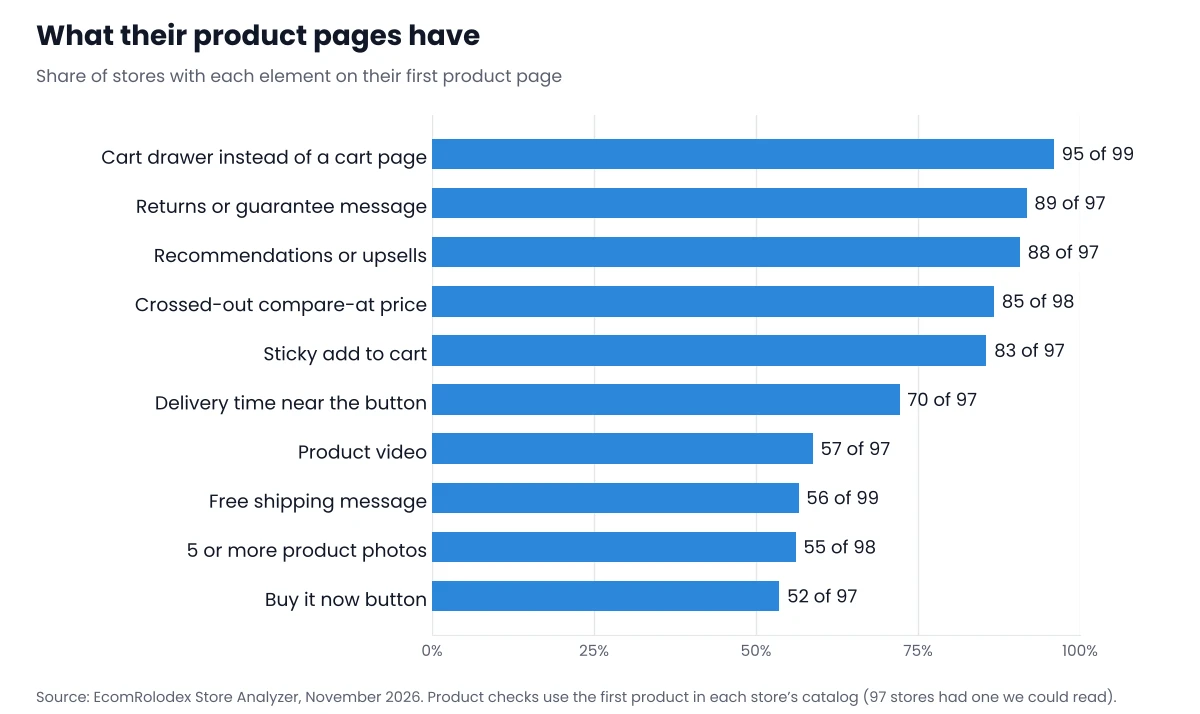
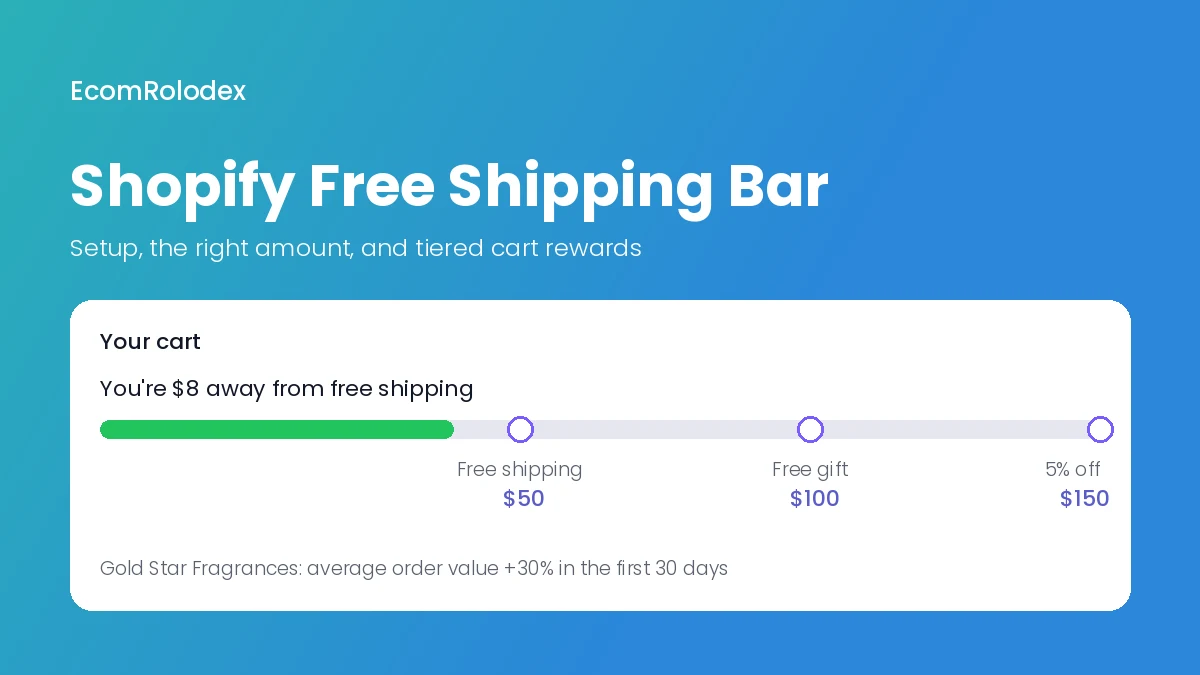
This is the part worth copying. Almost every scaling store has the same base: a cart drawer, a guarantee near the button, recommendations, a crossed-out price and a sticky add to cart on mobile. These match what we add on client stores, and on Gold Star Fragrances the cart rewards we built raised the average order value by 30% in the first 30 days (how the free shipping bar and rewards work).
Two things surprised me:
- Only 52 of 97 show a Buy it now button. My guess is that many hide it on purpose, so every buyer passes through the cart drawer and sees the bundles and upsells first.
- Only 11 of 98 put 80+ words in Shopify's product description field. The rest build the page with theme sections or a page builder. That looks great to shoppers, but Google Shopping and AI assistants read the product data, where these stores look almost empty.
Also: 23 of 98 had at least one sold out variant among their first 12 products. Selling out is a good problem, but a sold out variant on an ad's landing page is money lost.
The basics most of them skip
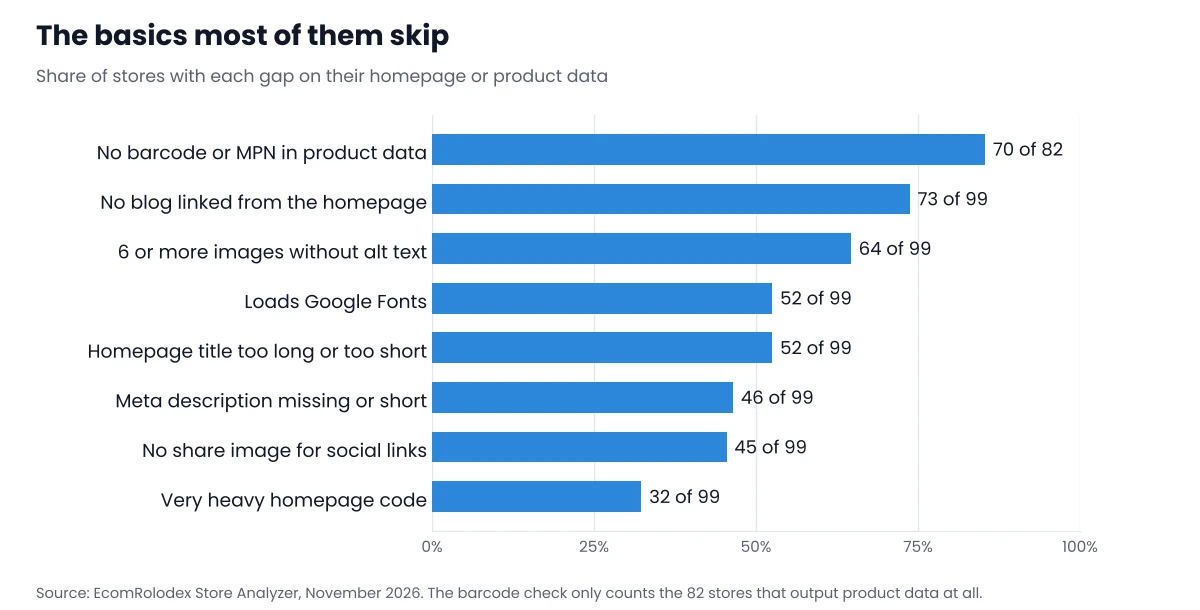
These stores live on paid ads, and it shows. Most skip the free traffic basics: a blog, alt text, a proper title and meta description, and a share image so links look good on WhatsApp and Facebook. None of them takes more than an afternoon to fix.
The homepage code is heavy too: the median homepage sends almost half a megabyte of page code before a single image loads, and 32 of 99 send around two thirds of a megabyte or more. That's mostly page builder sections and app code, and it's one reason mobile pages feel slow.
Are they ready for AI shopping?
Partly. None of the 99 blocks ChatGPT, Perplexity or Google's AI bots in robots.txt, and 82 of 97 product pages give Google product data with a price and stock status. But only 12 of those 82 include a barcode (GTIN) or MPN, which Google Shopping and AI assistants use to match and compare products. Adding barcodes to your variants in Shopify is a quick job on a small catalog, and most stores haven't done it.
What I'd copy, and what I'd fix
If you're building or fixing a store, this is the order I'd use, based on what these stores do and what works on our client stores:
- Email capture first. 90 of 99 have it. Klaviyo or Omnisend, a welcome offer and the basic flows.
- A cart drawer with an offer inside. Bundles, a free shipping bar or tiered rewards. This is where the order value goes up.
- The product page base: guarantee near the button, delivery time, a crossed-out price, sticky add to cart, 5+ photos and a video.
- Reviews with photos. Judge.me is the most used and has a free plan.
- Clarity from day one. It's free and shows you where people get stuck.
- Then the free traffic basics these stores skip: barcodes, alt text, titles, descriptions in the product field, and a blog that answers buyer questions.
- Keep apps under 10 on the homepage. The median scaling store manages with 7.
Want to see how your store compares? Our free Shopify Store Analyzer runs the same checks we used for this study and gives you 20+ tips in under a minute.
Want the list of all 100 stores?
It's a spreadsheet with every store, its country and whether it's dropshipping or private label. Send me a message and I'll share it with you.
How we did this study
- When: November 14, 2026.
- Which stores: 100 Shopify stores from our November 2026 list of stores spotted scaling with ads. 99 could be analyzed.
- How: our Store Analyzer opened each store's homepage, its product catalog and its first product page, the same way a visitor's browser would. We found apps by the code they add to the page (scripts, app embeds and their domains).
- What we can't see: apps that only run in Shopify's pixel sandbox (like the Meta and Google channels), apps that only show in checkout, and apps that load after a click. So these numbers are a floor: the real share can only be higher.
- Product checks use the first product in each catalog, which isn't always the best seller.
Using this data: you're welcome to use these numbers and charts in your own articles. Please link to this page as the source.
Frequently asked questions
What are the most popular Shopify apps on scaling stores?
In our study of 99 scaling stores: Klaviyo (89 stores), Kaching bundles (66), Microsoft Clarity (60), Triple Whale (50), Judge.me (38), GemPages (38) and UpCart (29).
What is the best Shopify theme for a dropshipping store?
The most used theme among the stores we analyzed was Shrine (30 of 99), then the free Dawn theme (22). A paid theme gives you more sections out of the box, but stores on Dawn scale too when the product page and offers are right.
How many apps should a Shopify store have?
The median scaling store in our study loads 7 apps and outside scripts on its homepage, and only 6 of 99 load more than 15. Keep the ones that capture emails, raise order value and show you visitor behavior, and remove the rest.
Do scaling Shopify stores use page builders?
Yes, 63 of 99 do. GemPages is the most used (38 stores), then PageFly (14) and Replo (12). They're used mostly for product and landing pages built for ads.
Want your store to look like these on the inside?
Send me your store link. I'll compare it with what scaling stores do and tell you the first 3 things to change.